
A Brief Introduction
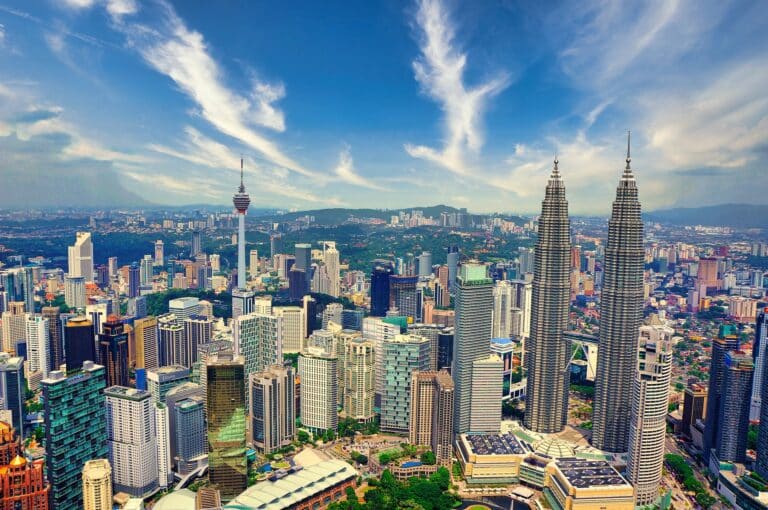
Kuala Lumpur’s urban landscape is comprised of sparkling skyscrapers and historic architecture. The world-famous Petronas Twin Towers, the Petaling Street flea market, and the approximately 400 million-year-old Batu Caves are just a few of the many well-known monuments of Malaysia’s capital city.
The city’s primary hub is the Golden Triangle, comprised of Bukit Bintang, KLCC, and Chinatown. The vast shopping complexes Pavilion KL and Suria KLCC are among the city’s most popular attractions. These large shopping establishments host a wide choice of expensive labels from all over the world. Foodies have lots of good reasons to enjoy Kuala Lumpur.
Thousands of hawker booths, cafes, and restaurants throughout the city serve every imaginable food. Outside of Kuala Lumpur’s glass, steel, and concrete, there are numerous green spots and natural attractions for relaxation. You may explore lush forested hills with hiking routes leading to waterfalls within a short drive of the city.
Kuala Lumpur
The diverse population of Kuala Lumpur provides international students with the opportunity to learn about other cultures, eating practices, and lifestyles. In Malaysia, one of the world’s most famous tourist destinations, students can spend their free time in tourist attractions, shopping malls, and other entertainment hubs while appreciating the country’s visual beauty. In addition, many Malaysian universities are located in the heart of the city, catering to the daily needs of international students in Malaysia.
Here are some reasons why Kuala Lumpur is a hot favourite city for students:
Diverse Multicultural Environment
About 1.8 million people call Kuala Lumpur their home. It’s like a cultural melting pot where different traditions and customs create something extraordinary for visitors. Kuala Lumpur, the capital of Malaysia, is a vibrant metropolis where traditional Malaysian hospitality meets modern elegance.
When you visit Kuala Lumpur, one of the first things you will notice is the extraordinary blend of diverse cultures. Malay Muslims, Indian Hindus, and Chinese Buddhists are the country’s three main ethnic groups. One can see and feel the expressive fusion of Malay, Chinese, and South Indian cultures throughout the city.
Various fascinating religions, cuisines, places of worship, sartorial styles, languages, and more come with these three unique groupings. With so many different cultures in the vicinity, the city is alive and full of colour. Not only is a wide range of cultures represented here, but there is also a nice contrast between urban and rural areas.
In recent years, we have seen that there has been a dramatic expansion of multiculturalism in the education sector. Universities worldwide are working to make their student bodies and faculty more diverse. They are doing this by offering initiatives to encourage more people from all walks of life to apply.
Studying in a multicultural environment has enormous benefits. Diversity and multiculturalism offer numerous benefits to university students and higher education institutions. The best ideas in education are the result of a collaborative process that has exposed them to as many different perspectives as possible.
Diverse perspectives from both students and teachers contribute to more vigorous dialogues, which in turn yields stronger, more well-rounded ideas. Graduates of multicultural institutions are more likely to have an international network of contacts, which helps them stand out to prospective employers.
As a result of the expansion of global markets, the lowering of trade barriers, and the emergence of China, Brazil, India, and African economies, businesses are going further afield for expansion prospects. This necessitates a staff conversing with different countries’ customs, languages, and business practices. These abilities will be essential for launching new firms and establishing long-lasting, fruitful working partnerships.
Because of its rich cultural diversity, Kuala Lumpur is an excellent place for students from all over the world to study. Graduates will benefit from the city’s multicultural exposure and understanding of diverse cultures and practise, allowing them to work with confidence wherever in the world.
Affordable Cost Of Living
Kuala Lumpur’s affordable cost of living is a major attraction for international students considering attending university there. Costs for either on- or off-campus housing are reasonable.
While your exact cost of living will be determined by factors such as where you choose to stay and how you want to spend your time, students will be happy to know that Kuala Lumpur is among the world’s least expensive cities. Most students can get by on a monthly stipend of RM2,000 (about US$500) in Malaysia.
The amount you spend on yourself each month highly depends on how you live your life. However, you should expect to pay anything from RM500 (about $100) to RM800 (about $200). This covers necessities for socialising, toiletries, a haircut, clothing, a movie, etc.
Using the above data, the average student will spend around RM24,000 (around $6,000) each year on living expenses. It is vital to keep in mind that the above estimate is merely a reference when calculating your budget to study in Malaysia, and that your geographical region and personal lifestyle should be taken into account while planning your own budget.
The cost of living and education expenses are discussed in greater detail in our supplementary guide.
Safe & Peaceful City
There are no known natural hazards in Malaysia due to the country’s location in a geographically protected area.
Malaysia ranks as the world’s 18th most peaceful nation. With a relatively low overall crime rate, it is widely regarded as one of the safest countries in the world. In 2022, the Global Peace Index (GPI) placed Malaysia in the 18th position as the safest nation in the world. This was an improvement of four places from the previous year. Additionally, in the Asia-Pacific area, Malaysia ranked #4 for a peaceful environment.
In addition, because of its cutting-edge infrastructure and well-developed public transit network, Malaysia is an excellent country to live, study, and find gainful employment. Additionally, in the Asia-Pacific area, Malaysia ranked #4 for a peaceful environment.
Malaysia’s modern infrastructure and extensive public transportation system make it a great place to live, learn, and work.
Leading Universities
Increased collaborations with educational institutions in other countries make up a sizeable portion of Malaysia’s government’s overall spending on higher education in the country. As a result, there are a large number of private universities and colleges in Malaysia that provide, in a variety of ways, a gateway to other international universities.
Some of the Top Private Universities in and surrounding areas of Kuala Lumpur
- Taylor’s University
- Monash University
- Nottingham University
- Herriot-Watt University
- University Of Cyberjaya (UOC)
- Asia Pacific University (APU)
- International Medical University (IMU)
- MAHSA University
- UCSI University
- HELP University
- SEGi College
The Bottom Line
In Brief, Kuala Lumpur is one of the best student cities in Malaysia since many of the top universities in Malaysia are located in the city. Kuala Lumpur is, without a doubt, the most popular and well-known city for those seeking to study in Malaysia.
To enrol at a university in Kuala Lumpur, prospective students must ensure they meet the prerequisites for their chosen degree programme. Admissions requirements vary by school. However, having finished secondary school is a universal prerequisite.
Learn more about the university admissions process in Malaysia by scheduling a free consultation with Edmates.